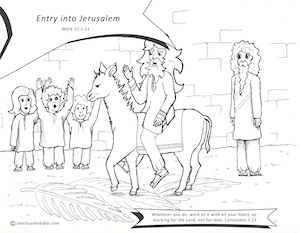
This is the story most commonly celebrated on Palm Sunday and is referred to as the "Triumphal Entry." We refer to this as the "Entry into Jerusalem" to give children easy words to use, but you can certainly teach them the traditional title of this story.
Jesus was on his way to Jerusalem with his disciples to celebrate the Passover Feast. They were traveling the road from Jericho to Jerusalem, so they passed by the Mount of Olives and the villages of Bethany and Bethphage. Jesus told his disciples to go ahead of him to one of those villages to find a young donkey that no one had ever ridden and bring it to him. Anticipating a question from a confused (and probably unwilling!) owner of a donkey, he told them to just tell the person, "The Lord needs it."
The disciples brought the young donkey to Jesus, put their cloaks (or coats) on the donkey as a makeshift saddle for Jesus. As Jesus road this donkey, people threw their cloaks and palm branches on the road to make a path for the donkey to walk. All the while, they were shouting, "Hosanna! Blessed is the one who comes in the name of the Lord! Blessed is the coming kingdom of our father David! Hosanna in the highest heaven!" (Mark 11:9-10) Hosanna means "Lord, save us!"
This angered the Pharisees because they knew that the people were beginning to follow Jesus and associate him with the promised Messiah. They told Jesus to make his followers be quiet. Jesus replied, "I tell you, if they keep quiet, the stones will cry out." (Luke 19:40)
To put this story in context, see this visualization of the chronology of Holy Week.
Where Is the Entry into Jeruselam (Triumphal Entry) in the Bible?
All 4 Gospels record the story of Jesus riding into Jerusalem. There are some minor differences between the tellings and (as is typical) the Mark version is the most concise (which is why we use it for this story).
Triumphal Entry in the Gospels:
- Matthew 21:1-11
- Mark 11:1-11
- Luke 19:28-44
- John 12:12-19
Reading all 4 accounts together provide some interesting differences and interpretive questions, though. For example, there are some differences in how the 4 Gospels describe the animal itself. Mark and Luke say that it is a tied-up colt. The word colt here could mean a young horse, or a young donkey. Matthew says that they found a donkey tied up along with its colt and the disciples brought back both of them. John shortcuts it and says "Jesus found a young donkey. Which is correct? All of them! They just tell the same story from a different perspective.
Also, 2 of the accounts (Matthew and John) provide the actual scripture from Zechariah 9 that is the prophetic basis for this act, which helps clarify that it was in fact a donkey and not a young horse.
Why Did Jesus Go to Jerusalem?
Jesus was going to Jerusalem to celebrate the Passover Feast. The symbolism of this should not be overlooked. The Jews celebrated the Passover Feast as was commanded them after they were delivered from the Egyptians. The angel passed over the Israelite households that had the blood of the Passover Lamb over their doorways. Jesus was about to become the ultimate Passover lamb, saving all who would believe from the judgment of God by his own blood.
You can read more about the original Passover in Exodus 12.
Why Did Jesus Ride a Donkey?
Jesus asked his disciples to get a donkey to emphasize his humility in contrast to the hopes of the Israelites at that time - that Jesus would become a military or political king and deliver them from the Romans. It was also in fulfillment of the prophecy found in Zechariah 9:9. Jesus came as the real King, but a King of peace who came to save, not to fight Rome.
Also, the fact that Mark and Luke record that the donkey was to be one that had never been ridden before would have made Jews at the time think about sacrificial and ceremonial animals from the Hebrew scriptures that were to have never been used before (see Numbers 19:2; Deuteronomy 21:3; 1 Samuel 6:7).
What Did the Crowd Do with the Palm Branches?
Traditionally, when we celebrate the Triumphal Entry, we wave palm branches as we say "Hosanna! Blessed is the one who comes in the name of the Lord!" But if you read the 4 Gospel accounts closely, you will notice that none of them actually outright says that they waved the branches, and only John says that they were palm branches.
They do say specifically that they laid down their cloaks and their branches on the ground to "roll out the red carpet" for Jesus. So were do we get the tradition of waving the palm branches?
The crowds were shouting Psalm 118, part of the "hallel Psalms" that were sung at many of the feasts. Matthew quotes the people shouting Psalm 118:26, but the very next verse says "The Lord is God.
He has been good to us. Take branches in your hands. Join in the march on the day of the feast. March up to the corners of the altar." (Psalm 118:27)
Other Jewish writings from before the time of Jesus also linked Psalm 118 with the Feast of Sukkot (or the Feast of Booths). In Leviticus 23:40, they were to celebrate like this: "On the first day you must get branches from palms, willows and other leafy trees. You must be filled with joy in front of the Lord your God for seven days."
Why Were the Pharisees and Religious Leaders Upset?
The religious leaders heard the people calling Jesus the "Son of David," the "King of Israel," and bringing the "kingdom of our father David." Combine that with Jesus intentionally fulfilling Zechariah 9:9-10 and everyone knew what was happening. It wasn't the first time Jesus had claimed to the coming Messiah, but now that the religious leaders saw all of these people praising him, they could not turn back from their plan to kill him. They were acknowleding what Jesus had claimed and he would not rebuke them publicly. They had a political and religious mess on their hands if they were to retain power.
In John, we see their jealousy for what it was: "Look how the whole world is following him!" (John 12:19) And the Sadduccees had worked with Rome to keep themselves in political and religious power while giving the Roman government what they wanted. A crowd shouting about a new "King of Israel"? That wasn't going to work.
This also set in motion Jesus again predicting his death and the clearing of the temple, which is our next lesson.