Mary Anoints Jesus with Perfume Story Summary for Kids
Shortly after Jesus raised Lazarus from the dead, they threw a dinner party for Jesus in Bethany. During the dinner, Mary poured a bottle of expensive perfume on Jesus' feet and washed his feet with her hair. Judas, pretending to care about the poor, scolded her for wasting so much money. But he didn't actually care about the poor, he was stealing money from the group. Jesus told the group that she was symbolically preparing him for his burial by pouring oil on him.
A Dinner in Bethany After Lazarus Was Raised (John 12:1-2)
This story happened directly after Jesus raised Lazarus from the dead, in the same town (Bethany) where it happened. Can you imagine the very interesting dinner conversation?!
Also, notice Martha serving dinner again while Mary does something else! But there was no disagreement this time. It seems like they worked through their conflict from earlier.
Mary Pours Perfume on Jesus’ Feet (John 12:3)
Some translations say that Mary poured "oil" on his feet while others say she poured "perfume." Which was it? Both! Mary used a perfume made out of nard (or spikenard), which is an aromatic essential oil. And she poured a lot of it on his feet! She poured a pound of the oil on his feet. Some translations give us the liquid equivalent - about a pint. Think about how perfume is used and then imagine pouring a pint of it out at one time. You can see why this was such a memorable event.
Judas Complains About the Cost (John 12:4-6)
Judas was offended by the apparent waste and excess of this act. He estimated that the oil would have been worth about 300 days wages. That's a lot of money! Perhaps younger kids can't visualize that, but older elementary students can get an idea of how much money it was if they think about their parents working for almost an entire year just to buy one thing.
But Judas wasn't being honest about his motivation. John is careful to let us know that Judas was stealing money from the "moneybag," the shared money that Jesus and his disciples had to live. Remember, they were traveling from town to town without a home of their own. So this money was being used to pay for things like food and shelter along the way.
When did the disciples learn about his stealing? We don't know. Perhaps they were aware of it along the way, but were hoping Jesus would confront him about it. Perhaps they found out after the fact. Jesus surely knew about it, but in his wisdom he chose not to intervene.
Jesus Says Mary Is Preparing Him for Burial (John 12:7-8)
For a while, the Jewish leaders had planned to kill Jesus for the things he was saying, and Jesus was predicting his death to his disciples frequently. Given how much time Jesus spent with Mary, Martha and Lazarus, it isn't hard to believe that Mary had a sense that things were coming to a climax.
Spices and oils were used to embalm the bodies of the dead in preparation for burial. See Luke 24:1-2
The practice of anointing with oil was used in the Old Testament as well, for various purposes. See Exodus 30:22-38 for the instructions Moses was given on Mt Sinai.
What Happened Next (John 12:9-12)
Word got around that Jesus was back in Bethany after the amazing miracle of raising Lazarus from the dead and a large crowd gathered at the house. The Jewish leaders of the day were getting increasingly concerned about Jesus, so this event really kicked into high gear their preparations to put him to death.
They also wanted to put Lazarus to death because so many Jews were coming to faith in Jesus because of his testimony. This is just a bit amusing, though. Jesus raised him from the dead once - couldn't he do it again if he wanted to?!
We see in the Mark version of this story (see Mark 14:10-11) that immediately after Mary anointed Jesus with perfume, Judas left to make his plans with the Jewish leaders to betray Jesus.
The next day, Jesus entered Jerusalem on what we now call Palm Sunday.
Questions About Mary Anointing Jesus
This story is the subject of considerable debate and confusion. We've sought to answer some common questions below.
Which Mary Anointed Jesus?
Mary of Bethany, sister of Martha and Lazarus anointed Jesus, not Mary Magdalene. There are many Marys in the gospels, but John is clear about which Mary it is by identifying the town and her siblings.
Did Mary Pour the Perfume on Jesus’ Head or His Feet?
Both. John says that Mary poured the perfume, or oil, on Jesus' feet. Matthew and Mark say she broke an alabaster jar and poured it on his head. Both can be true. She poured the oil on his hair and it ran down to his feet. Perhaps John wanted to capture the similarities between what Mary did for Jesus and what Jesus turned around and did for the disciples when he washed their feet?
Was Jesus Anointed Twice? (Luke 7 vs. John 12)
According to most chronologies, this event occurs just before Holy Week (which begins on the Sunday before the Crucifixion with the Triumphal Entry). We include it here in the "Preparing for the Crucifixion" section as Jesus clearly points to his impending death and burial within the story.
All four gospels record an event where Jesus was anointed with costly oil by a woman. The question is whether it is one event told in all four gospels, or whether there were two different events, one recorded in Matthew, Mark, and John and a separate event recorded in Luke.
The story in Luke 7:36-50, however records different people involved. It is an unnamed "sinful woman" at a different person's home (Simon the Pharisee). We focus on the John account in telling this story.
My Notes
What You Will Need
Supplies
- Anointing oil, olive oil, perfume, or spikenard anointing oil (Buy on Amazon)
Video Options
From LifeKids
From Saddleback Kids
From Crossroads Kids Club
Resource Sheet
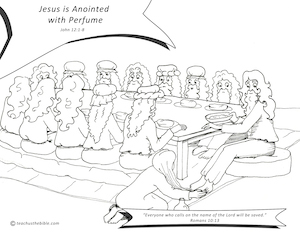
This coloring sheet depicts Mary anointing Jesus with oil as he was eating.
1Warm Up get your kids talking and engaged
Does your mom wear perfume? Or your dad cologne? Do you like the smell of it? Do you ever wear perfume, cologne or other smelly things?
Today, we're going to learn about a time in the Bible when someone poured a bunch of expensive perfume all over Jesus!
2Teach the Story teach a holistic story
Read story from a Children's storybook Bible for younger children.
For older children, read the story from an age-appropriate Children's storybook Bible or tell the story yourself.
3Bible Mastery give them basic Bible skills
4Comprehension Questions make sure they understand the story
First, ask the children if they have any questions about the story. What to do if you don't know the answer?
- What city did this story happen in?
- Bethany, the same city Mary, Martha, and Lazarus lived in
- What had Jesus just done for Lazarus?
- Raised him from the dead
- What do you think they talked about over dinner?
- Who knows? But I'm guessing some people had some questions for Lazarus!
- Who was cooking and serving the meal?
- Martha
- Who poured the perfume all over Jesus?
- Mary
- What did she wipe Jesus' feet with?
- Her hair
- Why did Judas get upset?
- He said that the perfume was expensive, and should have been sold so they could give the money to the poor
- What did he really want to do with the money?
- Steal it for himself
- Who else have we recently learned about that would steal money from others?
- Zacchaeus
- What did Jesus say Mary was doing?
- Preparing him for his burial
5Faith Questions open up a conversation about faith and the gospel; close with prayer
- Mary spared no expense to show her love for Jesus. She poured out an expensive jar of perfume to honor him.
- How can we honor Jesus with our lives, like Mary did?
6Memory Verse hide God's Word in their heart
All 12 activities below are free to use with no sign-up — complete with instructions, supply lists, and an age label for all-ages, early elementary, or late elementary classes.
Perfumed Feet
- Trace your feet.
- Use a cotton ball to wipe perfume onto the feet.
Mary's Hair Craft
- Glue yarn onto Mary's head.
- Dip the cotton swab into perfume and wipe it onto the perfume bottle.
Anointing Lesson
The basic meaning of the Bible word "anoint" is "to pour on, smear all over or rub into."
- In the Old Testament, someone who was anointed by God for special service to God, had oil poured or smeared on him.
- For instance, Saul, and later David, was anointed with oil by the prophet Samuel when God revealed He had chosen him to be king of Israel.
- The origin of anointing was from a practice of shepherds.
- Lice and other insects would often get into the wool of sheep, and when they got near the sheep's head, they could burrow into the sheep's ears and kill the sheep.
- Ancient shepherds poured oil on the sheep's head.
- This made the wool slippery, making it impossible for insects to get near the sheep's ears because the insects would slide off.
- Anointing became symbolic of blessing, protection, and empowerment.
- Anointing is done as an act to show holiness or being set apart.
The following verses are examples of anointing in the Bible. Read different versions of the Bible to get a full understanding.
- Exodus 30:22-33
- 1 Samuel 16:13
- Psalm 89:20
- Psalm 133:1-3
- Mark 6:13
- In Luke 4:16-19, Jesus quotes Isaiah 61:1-2
- James 5:14
- 1 John 2:20
As a believer in Jesus Christ you have authority to pray over yourself and others and expect victory (see Mark 16:17-18).
- Rub some oil onto your students' heads and pray over them.
- Rub oil onto your classroom doorway and pray over your church building that God will be honored in all you do.
Mary, Martha, Lazarus, Judas Game
- Call out the names quickly. the kdis have to try to keep up with the motions!
- Intrduce the motions for each character
- Mary- Sit down
- Martha- Pretend to sweep with a broom
- Lazarus- Lay down
- Judas- Cross arms and frown
Sniff and Guess Activity
- Put scents onto cotton balls or cups
- Provide writing utensils and paper for them to write their guesses.
- Have them pass around the scents and write on their paper what they think it is.
- vanilla
- lemon
- wd40
- cinnamon
- pine cleaner
- peppermint
- soy sauce
- apple cider viengar
Make Perfume Bottles
- Paint glue onto jar and add pieces of tissue paper to decorate the jar.
- Put some perfume onto the cotton ball or cloth.
- Place inside baby food jar.
Scented PlayDough
- Give each child a ball of playdough.
- Add a few drops os your chosen scent to each ball of playdough
- Allow kids to knead the playdough to disperse the smell.
- Put in plastic containers or ziplock bags.
Make Perfume
- Remove a handful of rose petals from stem and gently wash them.
- If using lavender flowers and leaves, remove them from the stems, as well.
- Place flowers in a glass jar.
- Add about a cup of filtered water.
- Place lid on the jar and shake gently for about a minute.
- Place in a sunny window for a week.
- After a week, you can strain out the flowers.
- If desired, you can leave a couple of rose petals inside and tie a ribbon around the jar for decoration.
Steal the Moneybag
- This game is based on "Steal the Bacon, but instead of bacon, they will be stealing a moneybag.
- Tie up 15-20 coins in a piece of fabric to simulate a moneybag
Game Instructions:
- Divide group into two equal teams.
- Stand the teams in two parallel lines facing each other, about 15 to 25 feet apart.
- Place the money bag right in the center of the space.
- Count off each team from opposite directions so that players facing each other share the same number.
- A non-playing leader calls out a number.
- The players assigned to that number sprint to the center to grab the moneybag.
- If a player grabs the moneybag and makes it back across their team's line without being tagged, their team scores a point.
- If the opponent tags the player holding the moneybag before they cross home, the tagging team gets the point.
- Neither player can tag the other until someone actually touches the moneybag first.
Reed Diffusers
- Give each student a glass vase. (The smaller the opening the better).
- Wrap a ribbon around the vase and tie in a bow for decoration.
- Add baby oil and essential oil to the vases.
- Place bamboo skewers into the vase.
- You might have to cut the skewers, depending on the size of your vase.
How Much Is It Worth?
- Choose 3 people randomly from the group.
- Provide an item to show.
- Each child secretly chooses the price they think the item is worth.
- Reveal their guesses. Whoever got closet wins that round.
- Play as many times as deisired to include as many kids as desired.
- Provide a prize for the kid who get the most guesses correct.
- Talk about what the perfume Mary used was worth.
Item Ideas:
- Large pizza
- Lego Set
- Bottle of water
- Nike Sneakers
- Switch
- iPhone
- Can of soda
- Fast food meal
- Xbox controller
- Bag of candy
Mary anoints Jesus Crossword Puzzel
- Give each student a crossword puzzle.
- The answer key is on the second page.
Running a kids’ ministry or Sunday school?
Ministry Edition gives your whole team lesson scheduling and teacher tools — all in one place.