In this lesson, we are going to learn about the next major phase of Israelite history - the divided kingdom.
Journeying through the Old Testament, we have been through several major periods in the life of the Israelites:
The Patriarchs - Abraham, Isaac, Jacob and his 12 sons
Egyptian Captivity
The Exodus from Egypt into the Promised Land - Moses, Joshua
Judges and a pattern of rebellion
The unified Kingdom - Saul, David, Solomon
There were 3 major people involved in splitting up the kingdom of Israel: Solomon, Rehoboam, and Jeroboam. First, the names Rehoboam (pronounced Ree-uh-boh-am) and Jeroboam (pronounced Jair-uh-boh-am) sound a lot alike, and are pretty funny names. Don't let the opportunity pass by to engage the children with how funny their names are...
Solomon
Solomon was David's son and was king. If you remember from the last lesson, Solomon built the temple of the Lord and was very wise. But just because he knew right from wrong doesn't mean he always followed it. Solomon ended up with hundreds upon hundreds of wives and many of them were not from Israel. He ended up worshiping the gods of his wives and turned away from the Lord. God then judged Solomon and told him that he would take the kingdom away from him, but because of David's faithfulness, he would leave part of the kingdom intact (with Jerusalem) to fulfill the promise he made David. (see 1 Kings 11:1-13) This is the essence of why the kingdom was divided. Next we are going to learn about how it actually happened...
Rehoboam
Rehoboam was Solomon's son and the next in line to be King. Remember the warning Samuel gave the Israelites when they first asked for a king? Before Saul was appointed? (see 1 Samuel 8:11-18) Solomon's building projects required heavy forced labour from the people. When Rehoboam prepared to take the throne, the people came asking for relief from that burden.
Rehoboam asked two groups of advisers what to do. First, he asked the elders who had served with Solomon. They urged him to lighten up and give the people what they wanted so they would continue to serve him. Then he asked some younger folks, a crew of people he had grown up with. You can see them flattering Rehoboam and telling him to be even more heavy-handed with them. They were drunk with power. (See 1 Kings 12)
So Rehoboam answered the people: "He said, 'My father put a heavy load on your shoulders. But I'll make it even heavier. My father beat you with whips. But I'll beat you with bigger whips.'" (1 Kings 12:14). This is what planted the seeds of division in the people of Israel.
Jeroboam
Jeroboam was an important man in Solomon's kingdom. He was a skillful worker and was put in charge of all the workers of Northern Israel. A prophet named Ahijah (bless you!) told him, though, that God was ripping the kingdom from Solomon's hand and that he would be king of 10 of the tribes of Israel. Here's how that prophecy came true...
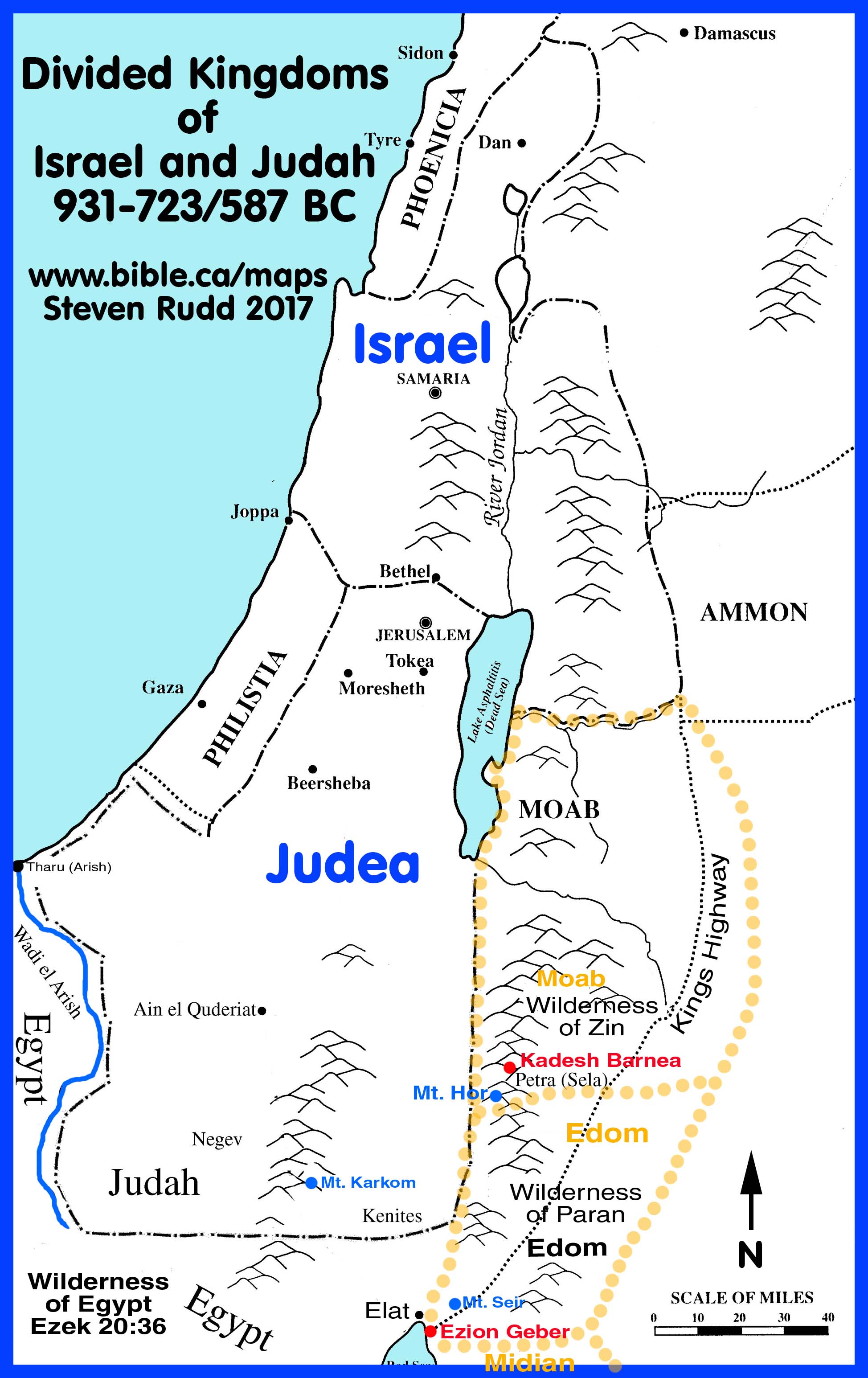
In 1 Kings 12:20, we see that the people became so fed up with Rehoboam that they asked Jeroboam to be their king: "All of the people of Israel heard that Jeroboam had returned. They sent for him. They wanted him to meet with the whole community. Then they made him king over the entire nation of Israel. Only the tribe of Judah remained true to David's royal family." And thus, the kingdom had been split with Rehoboam over the tribes of Judah and Benjamin (see 1 Kings 12:23) in a kingdom called "Judah" and Jeroboam over the rest of the tribes in a kingdom called "Israel".
Jeroboam was afraid that his tribes would have to go to Jerusalem to worship (since the new temple was there), and that they would sympathize with Judah while they were there. So, he created golden calves for the people to worship near home (sound familiar?).
Why did God tell Solomon that he was going to take away part of the kingdom from his descendants?
Because Solomon turned away from the Lord and worshiped false gods
Who was Solomon's son?
Rehoboam
Why did the people turn against Rehoboam?
Because he said he was going to be a harsher king than Solomon was
Who told the Israelites that they would be sorry that they asked for a king?
Samuel
Who became king over the 10 tribes that decided to leave Rehoboam?
Jeroboam
What were the two kingdoms named?
Judah - Rehoboam was king, Israel - Jeroboam was king
Which kingdom was Jerusalem in?
Judah
Did Jeroboam stay faithful to God?
No - he led his kingdom to worship false gods because he didn't want them going to Jerusalem
5Faith Questions open up a conversation about faith and the gospel; close with prayer
Even though God made a promise to Israel, they still had to make the decision to continue to follow him.
God promises that he will forgive our sins and give us eternal life, but we must ask him and repent from our sins. Have you ever done that?
6Memory Verse hide God's Word in their heart
Your heart will be where your riches are. Luke 12:34
Crafts, Games, and Activities for Divided Kingdoms
9 activities
All 9 activities below are free to use with no sign-up — complete with instructions, supply lists, and an age label for all-ages, early elementary, or late elementary classes.
Type
Crafts
2
All
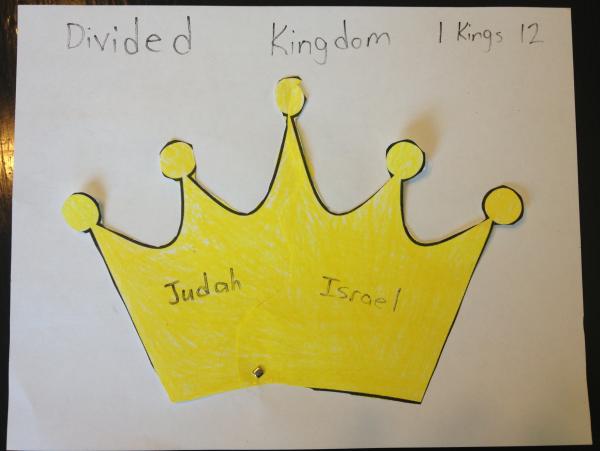
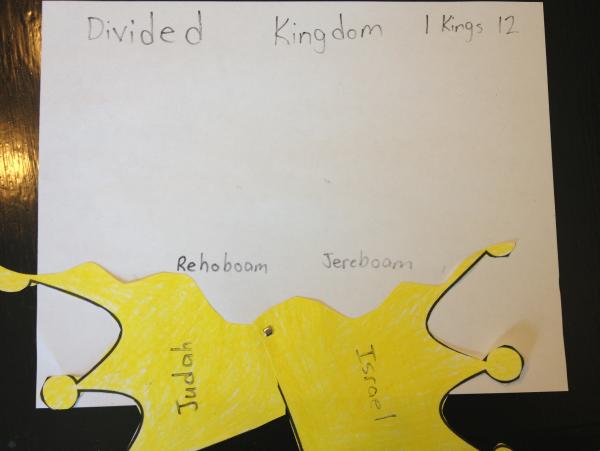
Fasten a paper crown together with brads to show the 12 tribes split between two kings.
4 supplies
Broken Crown
AllCrafts
Fasten a paper crown together with brads to show the 12 tribes split between two kings.
All of the people of Israel saw that the king refused to listen to them...So the people of Israel went home. But Rehoboam still ruled over the Israelites who were living in the towns of Judah. 1 Kings 12:16-17
Supplies
plain white sheet of paper
crown outline (see below)
crayons
brads
Instructions
use brads to separate 12 tribes. name of kings on crown
For older students, you could have them list the tribes that became part of Judah and Israel.
Cover a calf picture in glue and gold glitter, recalling that Jeroboam repeated Aaron's mistake.
4 supplies
Gold Glitter Calf
Early Elem.Crafts
Cover a calf picture in glue and gold glitter, recalling that Jeroboam repeated Aaron's mistake.
Heads up. This activity was introduced in the Golden Calf lesson
Then he made two golden statues that looked like calves. He said to the people, "It's too hard for you to go up to Jerusalem. Israel, here are your gods who brought you up out of Egypt." 1 Kings 12:28
Supplies
calf coloring pages (see resource sheets)
marker
glue
gold glitter
Instructions
Cover calf with glue.
Sprinkle gold glitter onto calf
Let glue dry.
This is a repeat activity because Jeroboam repeated the same mistake Aaron did!
Take down a golden calf picture piece by piece by answering questions about the story.
2 supplies
Golden Calf
AllGames
Take down a golden calf picture piece by piece by answering questions about the story.
Heads up. This activity was introduced in the Golden Calf lesson
Then he made two golden statues that looked like calves. He said to the people, "It's too hard for you to go up to Jerusalem. Israel, here are your gods who brought you up out of Egypt." 1 Kings 12:28
Supplies
picture of a golden calf
cut into puzzle pieces
Instructions
Print or color a picture of a golden calf.
Cut picture into pieces, like a puzzle.
Hang puzzle up on wall.
As students answer questions from the story, allow them to pull down one puzzle piece at a time, to take down the golden calf idol.
This is a repeat activity because Jeroboam repeated the same mistake Aaron did!
All of the people of Israel saw that the king refused to listen to them...So the people of Israel went home. But Rehoboam still ruled over the Israelites who were living in the towns of Judah. 1 Kings 12:16-17
Supplies
long rope
large play space
Instructions
Divide children into two teams.
Play tug of war.
Late Elem.
Relay a heavy load like a stack of books or a sandbag to a turnaround line and back.
1 supply
Heavy Load Relay
Late Elem.Games
Relay a heavy load like a stack of books or a sandbag to a turnaround line and back.
He said, "My father put a heavy load on your shoulders. But I'll make it even heavier. My father beat you with whips. But I'll beat you with bigger whips." 1 Kings 12:14
Supplies
2 of something heavy (lots of books, dog food bag, sandbag, etc)
Instructions
Split the class into two teams and set up for a relay
Create a starting line and a turn around line
Each team must carry something very heavy (a stack of books, a big bag of dog food, or a sand bag) from the starting line, to the turn around line and back.
First team to finish wins.
Story & Reflection
1
All
Split into two groups by preference, like pizza toppings or ice cream flavors, the way Israel divided.
No supplies
Divided Class
AllStory & Reflection
Split into two groups by preference, like pizza toppings or ice cream flavors, the way Israel divided.
Heads up. This would be a good introduction activity.
All of the people of Israel saw that the king refused to listen to them...So the people of Israel went home. But Rehoboam still ruled over the Israelites who were living in the towns of Judah. 1 Kings 12:16-17
Supplies
No supplies needed
Instructions
We all have opinions. The Israelites were divided over who their king was going to be. The tribes that became part of Israel did not like how Rehoboam was treating them. Judah felt a loyalty to Rehoboam, who was Solomon's son.
Divide class into two groups, according to preferences.
Cheese pizza vs pepperoni pizza?
Playing outside or inside?
Chocolate or vanilla ice cream?
Blue or green?
Science
1
All
Watch shaken oil and water separate in a jar, a picture of the kingdom splitting in two.
3 supplies
Oil and Water Split
AllScience
Watch shaken oil and water separate in a jar, a picture of the kingdom splitting in two.
All of the people of Israel saw that the king refused to listen to them...So the people of Israel went home. But Rehoboam still ruled over the Israelites who were living in the towns of Judah. 1 Kings 12:16-17
Supplies
water
vegetable oil
jar with top
Instructions
Pour half water and vegetable oil in a jar.
Shake up prior to showing students.
Allow students to watch as the oil separates.
Worksheets
2
All
Cut out the 12 tribes and glue each one on the Judah or Israel side of a sheet.
3 supplies
12 Tribes Split
AllWorksheets
Cut out the 12 tribes and glue each one on the Judah or Israel side of a sheet.
All of the people of Israel saw that the king refused to listen to them...So the people of Israel went home. But Rehoboam still ruled over the Israelites who were living in the towns of Judah. 1 Kings 12:16-17
Supplies
scissors
glue
cut out sheet for each student (see below)
Instructions
Cut out 12 tribes and glue onto correct side of paper using template below
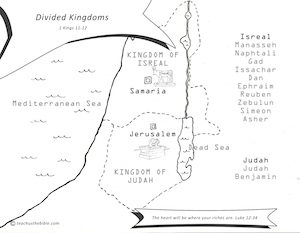
Judah: Judah, and Benjamin. (Rehoboam was king.)
Israel: Manasseh, Naphtali, Gad, Issachar, Dan, Ephraim, Reuben, Zebulun, Simeon, Asher. (Jeroboam was king.)
Color a map to show which tribes joined Israel and which joined Judah.
No supplies
Maps
Late Elem.Worksheets
Color a map to show which tribes joined Israel and which joined Judah.
All of the people of Israel saw that the king refused to listen to them...So the people of Israel went home. But Rehoboam still ruled over the Israelites who were living in the towns of Judah. 1 Kings 12:16-17
Supplies
No supplies needed
Instructions
Color map based on what tribes became part of Israel and which ones became part of Judah.
You can use the "Divided Kingdom" map below, or use this week's coloring sheet.
That's 5 lesson PDFs this month — which is right about where the free samples end and Ministry Edition begins.
Ministry Edition gives your whole team unlimited lesson PDFs, plus scheduling, teacher emails, and take-home sheets for parents.
Rate this Activity
Lesson Prep
Start your lesson planning by reading the "Lesson Prep" section about 5 days before you are scheduled to teach.
1
Background Scripture
While we provide a summary of the story, we strongly encourage you to read the story directly from the Bible for yourself. God's word is powerful (much more powerful than our summary is!) and you should know the story well before you teach it. We encourage you to read the background scripture 2–3 times during the week before teaching.
2
Story Summary
We provide a "Cliff's Notes" version of the story to help you see the big picture. Also, if you are not using a storybook Bible, you can use this summary as an outline for your own teaching in class.
3
What You Will Need
We place everything you might need to prepare for the actual story telling here (this doesn't include Reinforcement Activity supplies, because we don't know which ones you will choose!). This may include a snack suggestion if there is one that goes well with the story, props you might use in teaching the lesson, and the coloring sheet that goes with each lesson.
Lesson
This section helps you structure your teaching time.
1
Warm Up
This is a question that goes along with the story for the day. This is designed to get your kids talking and to build a connection with them.
2
Teach the Story
This is the most important part of the lesson. Use all the creativity you have to tell the story in an engaging, and interesting way. Use props. Be sensitive to the age of your children and tell the story in a way they can understand.
If you would like to have your students read out of the Bible themselves, these are good verses to do it. We recommend they do this after you teach the story, however, and certainly not as a substitute for you teaching a holistic story. While it is a good thing that kids get used to reading out loud and reading the Bible for themselves, elementary-aged children do not typically have the reading skills necessary to be able both read out loud and comprehend at the same time. Also, it is difficult for the other students to really understand what they are hearing. So teach the lesson first, then let them read the Scripture out loud.
4
Comprehension Questions
These questions can help you ensure your students understood the story. Also, use this time to take the topic where the students want to go. Pray for the Holy Spirit to reveal to them what truths he wants them to learn from the story, and help them understand how this story can be applied to their lives. Keep in mind that elementary school children are rarely capable of abstract thought, so don't boil it all down to a simplified principle for them. But let the Scripture and the Holy Spirit speak to them and be sensitive to where the conversation can go.
5
Faith Questions
These questions help the children think about how this story applies to their own life today. Keep in mind that only your oldest elementary school children will be able to think in abstract terms, but you can ask some basic questions that will hopefully open up a conversation about what the children believe. By the prompting of the Holy Spirit in response to His Word, you can encourage your children to surrender their lives to God and present the Gospel to them. Also, feel free to share your own faith experiences with them (being careful not to delve into "adult" struggles).
6
Memory Verse
We typically include a memory verse every 4 or 5 lessons, so you can work for several weeks on the same verse. Feel free to give out rewards to the students who successfully memorize the Scripture.
Reinforcement Activities
Use reinforcement activities to help your students remember the story. These activities are not just crafts and games.
Preparation
Several days before you teach, choose the activities you want to do with your class. Take note of any supplies that are needed. You might consider trying out crafts to make sure you know how to do them before you get to class.
Scripture
Every activity has a Scripture that helps you see the tie-in from the activity to the story. Make sure to help the students see the tie-in so they don't think you are just playing a random game.
When You Don't Know the Answer
Children naturally have questions. And sometimes, we don't know the answer! Here's what to do:
1Ask the child to say more about their question.
2Ask them what they think the answer may be. Perhaps they have the right answer and they just need confirmation.
3Pose the question to the whole class and see what discussion ensues.
4If all else fails, tell them that you don't know the answer (this is okay!) and that you will get back to them next week, but only if they will also think about it and do some research during the week as well. For younger students, you might write down their question on a piece of paper and send it home with them. But above all, follow up with the student the next week and continue your discussion with your newfound information.
(Adapted from "Children's Ministry in the Way of Jesus", by David M. Csinos and Ivy Beckwith)
Using Videos
Just wanted to point out here that you should follow all copyright laws when it comes to using videos.
Even if a video is on YouTube, that doesn't mean it is available for you to show in a group setting automatically.
Check with the video publisher for usage restrictions, whether you need to pay for a license to show a video, etc.
We include these videos as options for you to consider and for your own personal study.