Background Scripture (read 2-3 times during the week)
Story Summary
Passover is an 8-day observance commemorating the freedom and exodus of the Israelites (Jewish slaves) from Egypt. The Pharaoh's name is not recorded in the Bible, though many historians have suggested Ramses II.
The plague of the firstborn is a difficult one for young children to understand. The idea of all the baby boys being killed by an angel of God is even hard for adults to comprehend. You know your students. Give them as much as they can handle. The idea here is to set the foundation for an understanding of the Passover feast throughout the rest of the Bible.
There are several reinforcement activities that are centered on the Israelites leaving in a hurry and the unleavened bread. These activities are especially good for younger children that would not understand the plague of the firstborn.
The plague of the firstborn is the final straw for Pharaoh. He finally gives permission for the Israelites to leave Egypt. The Israelites are told to put blood from a lamb over their doorposts. God will pass over the houses marked with the blood. The Israelites had to leave Egypt in such a hurry that their bread did not have time to rise. This is why they celebrate the Passover feast with unleavened bread (without yeast). Matzah is commonly used as a staple during Passover. Traditionally, matzah is prepared quickly (often within about 18 minutes) to prevent rising. This is, again, representative of the Israelites leaving Egypt in a hurry.
Be sure to point out that the blood was to be from a lamb. Passover is foreshadowing symbol of what Jesus did on the cross. That is why he is called the "Lamb of God".
Reference other times in the Bible when the Passover feast is celebrated. Luke 2:41-52, Jesus' family was in Jerusalem to celebrate the Passover feast when they realized he was not with them on the way home. They found Jesus in the temple. He was thought to be about 12, at this point; John 12:12-19, Jesus was going to Jerusalem to celebrate Passover during the triumphal entry. He spent the Passover with his disciples. This is where he washed the disciples feet and taught them to serve others, just prior to his arrest.
My Notes
What You Will Need
Snack
unleavened bread (see reinforcement activity)
Video Options
From Crossroads Kids Club
From Faith Kids
Updated, from Crossroads Kids Club
Resource Sheet
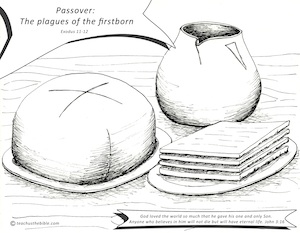
This coloring sheet focuses on the unleavened bread portion of the story, so it should be appropriate for all ages
1 Warm Up get your kids talking and engaged
Have a sample of unleavened bread and regular yeast risen bread. Ask students to talk about the differences.
You can do the "Red over doorpost" reinforcement activity before students come into the classroom to see who notices it.
Can you remember a time when you were in a big hurry to do something? In our Bible story today, the Israelites had to leave in such a hurry that they couldn't finish making their bread.
2 Teach the Story teach a holistic story
Older students can listen to the story (Exodus 12) directly from a readers version of the Bible, since it is only one chapter long.
Younger students can be read the story from a Children's Storybook Bible or be told a summary of the events. Make sure you have a good understanding of the story before you teach your class, if telling the story in your own words.
3 Bible Mastery give them basic Bible skills
Scripture for Kids to Read Aloud Exodus 12:13-17, 12:31-34
4 Comprehension Questions make sure they understand the story
First, ask the children if they have any questions about the story. What to do if you don't know the answer?
- Why did God send plagues on the Egyptians?
- He wanted his people to be free from slavery from the Egyptians
- How many plagues did God send to Egypt?
- 10
- What plague finally convinced Pharaoh to let the Israelite people go?
- Plague of the firstborn
- What did the Israelites put over their doorposts for God to pass over their houses?
- Blood from a lamb
- What did not have time to rise because they left in a hurry during the night?
- Bread
5 Faith Questions open up a conversation about faith and the gospel; close with prayer
- Just like in this story, only those who sprinkled the blood of the Passover lamb would be saved from the angel of death, only by Jesus' work on the cross can we be saved.
6 Memory Verse hide God's Word in their heart
All 8 activities below are free to use with no sign-up — complete with instructions, supply lists, and an age label for all-ages, early elementary, or late elementary classes.
Unleavened bread
- 1/4 cup oil
- 1/4 cup honey
- 2 teaspoons salt
- 3 eggs
- 1 1/2 cups water
- 6 to 6 1/2 cups bread flour or all-purpose flour
- Instructions:
- In a large mixing bowl, combine the oil, honey, salt, eggs, and water. Stir until well-mixed. Stir in about 4 cups of the flour, then add more flour as needed and knead into a fairly stiff dough.
- Divide dough into 3 pieces. On a lightly floured surface, roll out dough.
- Cut rolled dough into squares.
- Place squares onto lightly greased baking sheets. Prick with a fork. Sprinkle with salt if desired.
- 4. Bake in a preheated 375-degree oven for 10-20 minutes, depending on thickness. Should be very light brown on top. Do not overcook!
Active Yeast
- Mix 1 cup warm water, 2 1/4 tsp active yeast, 1 tbsp sugar. Watch for a few minutes until bubbles form. The yeast is what causes dough to rise.
Bread dough
- Make dough and allow students to watch it rise during class period.
- Make a second batch, but leave out the yeast.
- Compare the two batches.
- Have some rolls already baked for students to enjoy. Can add honey or butter.
- Recipe:
- 2 cups hot water
- 1/2 cup margarine
- 1/3 cup white sugar
- 2 teaspoons salt
- 1/2 cup cold water
- 2 (.25 ounce) packages active dry yeast
- 5 1/2 cups all-purpose flour
- 2 eggs
- Melt margarine in hot water. Add sugar and salt and stir. Add cold water and yeast. Stir to dissolve yeast.
- Add 3 cups flour and mix. Add eggs and 2 1/2 - 3 cups more flour. Mix, cover and let rise until dough doubles in size.
- Punch down and let rise 30 more minutes or until doubles.
- Make walnut size balls of dough. Place about 2 inches apart in well-buttered 9 x 13 inch pan. Bake in a preheated 350 degrees F (175 degrees C) oven for 30-45 minutes. Brush top of rolls with margarine while hot.
Understanding Matzah
Matzah is the Jewish name for unleavened bread. It is a thin, wafer-like cracker. The process of making Matzah should be completed in no more than 18 minutes from start to finish, including baking time.
This is to represent the dough that didn't have time to rise as the Hebrews quickly left Egypt. They put the dough on their backs, and while they were walking, the sun baked it into hard crackers. Matzah is eaten by Jews during the week-long celebration of Passover.
Ingredients
- 2 cups unbleached flour
- 1/2 cup water (more , if needed)
Instructions
- Preheat oven to 450 degrees
- Place flour in bowl
- Make a well in the middle of the flour and pour in water, Mix.
- Add more water, as needed until flour is mixed. Knead dough until soft, not sticky
- Roll into a ball. Divide into quarters.
- Roll each quarter into a circle. Place matzah on baking sheet and prick all over with a fork.
- Bake for 5 minutes on each side, or until edges are golden.
Red over doorpost
- Place a strip of red paper or red tape over doorpost, as a reminder of the Passover (you can do this before class if you would like).
- After the lesson, you can point out the red tape or paper and ask which of your students noticed it as they came into class.
Doorpost Craft
- Cut a door out of one sheet of paper. Keep it attached, so it can open and close.
- Place paper with door over a second sheet and glue together. Make sure door can still open and close.
- Make a mark over the door using a red marker or paint.
- Copy or attach a pre-printed verse inside the door.
- All of the people of Israel did just what the Lord had commanded Moses and Aaron. On that very day the Lord brought the Israelites out of Egypt like an army on the march. Exodus 12:50-51
Storytelling Bag
- This activity is to encourage the students to think through the whole story of Moses.
- Place random items in a bag.
- Have one student at a time pull out one of the items and explain how it can relate to the story.
- The items can relate to the entire story of Moses leading the Israelites out of Egypt.
- Example items:
- Plant- God appeared to Moses in the burning bush.
- Toy Frog- God sent frogs as one of the plagues to encourage Pharaoh to let his people go.
- Crown- Pharaoh was the ruler on Egypt
- Lego Man- has no shoes because Moses was told to remove his sandals.
- Wheat or grain- Moses was in Egypt with the other Israelites because Joseph stored up grain before a famine and the Israelites moved there for food.
- A basket - Moses' mother put him in a basket in the Nile river to keep him from being killed by the Pharaoh with the other Israelite baby boys
Compose a Psalm
- Tradition says that when the Jews celebrated the Passover feast, they sang the "Hallel" Psalms (Psalms 113 - 118)
- We don't have recordings of what tune they would have sung those Psalms to - we only have the lyrics
- Give your students a few verses from one of these Psalms and ask them to come up with a tune to sing
- You could allow them to choose, but that might take a very long time during class, so do some pre-work for them
- You might give each child a different verse, you might pair them up as a team, or you might do it altogether as a class depending on your kids.
- Give them 10 minutes or so in a quiet place if you can, and then bring them together to sing the Psalms to each other
- You might record it for them and play it for the parents
Running a kids’ ministry or Sunday school?
Ministry Edition gives your whole team lesson scheduling and teacher tools — all in one place.