The Good News of Jesus Christ Story Summary for Kids
Peter gave Cornelius and his household one of the clearest explanations of the Good News of Jesus in the New Testament. He had been sent by God to preach to the Gentiles and Acts 10:34-43 records his message to them. Here is the message of the Good News:
Jesus makes it possible for us to be at peace with God. God sent Jesus to earth to live a perfect life and show us how much God loves us. But the people he came to rejected him and his message and put him to death on a cross. God raised him from the dead on the third day to show that he has power over sin and death. Everyone who believes and trusts in Jesus will have their sins forgiven and be given eternal life with him forever.
Where This Picks Up from Peter and Cornelius
We learned in the last story, Peter & Cornelius, about the background to this lesson. We learned about Cornelius, a non-Jewish person who also had a vision of an angel who instructed him to call for a man named Peter. We learned about Peter's strange vision of unclean animals being lowered down on a sheet and being told to eat them. Then we learned about their meeting and how the church broke out from the Jews to include the Gentiles. This lesson breaks out from that story to focus on the actual message that Peter shared with Cornelius. If Peter were here today and gave us this same message, what should our response be?
What Is the Good News? Peter Says It in One Sentence
We prefer the New Living Translation for Acts 10:36 because it gives you a short but complete sentence that defines the Good News or Gospel: "There is peace with God through Jesus Christ." Kids can memorize that sentence. You can help them be ready to answer anyone who asks what their faith is all about. "There is peace with God through Jesus Christ!" That's it!
We are approaching the end of our journey through the stories of the Bible. These aren't just interesting stories about an obscure group of people in a particular part of the world in a certain period of history. They are collectively the Story of God seeking to redeem humanity through his chosen people and through his Messiah. It does us no good to just learn the stories but not respond to them personally. The more we learn about Jesus and what he did, the more we learn about God and how he made it possible for people who mess up to still be at peace with God. Peter's message to Cornelius makes us answer the question: "Do you have peace with God?"
(We use the words "Good News" instead of "Gospel" as we are teaching this to kids. Gospel is a great word for kids to know, but they must be taught what it means. So we start with Good News and teach them that they might hear it referred to as the Gospel.)
Jesus Went Around Doing Good
Sometimes we think about the Gospel as only about the two big holidays, starting at Christmas and ending at Easter. Jesus was born as God become flesh, and then he died and rose again. But what about all the stuff he did in the middle of those two big events? Does any of that matter? Peter's message includes a summary of Jesus' life: "Jesus went around doing good and healing all who were oppressed by the devil, for God was with him." (Acts 10:38) Jesus lived a perfect, sinless life because he was God become Man. He was the perfect Man who showed us what God's plan was from the beginning.
They Put Him to Death and God Raised Him on the Third Day
We spent 7 lessons in the "Crucifixion and Resurrection" section learning about this, and Peter just says it in one short sentence: "They put him to death by hanging him on a cross, but God raised him to life on the third day." (Acts 10:39-40) Jesus became the Passover Lamb to deliver us from death. Lots of people have died (nearly everyone in fact! We won't get into Enoch and Elijah here...) and lots of people were put to death on a cross by the Romans. Jesus' resurrection is what separates him from all of those people. Not only did he die for our sins, but he made it possible for us to have his eternal life!
Everyone Who Believes in Him is Forgiven
How do you get this peace with God? Peter answers the question this way: "Everyone who believes in him will have their sins forgiven through his name" (Acts 10:43). It is important to understand that the word "believe" in the New Testament is not just about answering the question, "Do I think this happened or not?" It means "Am I willing to place my trust in this fact?" Whether Jew or Gentile, Peter helps us understand that we can put all our trust in Jesus to forgive our sins and make us at peace with God.
Sharing the Good News with Kids
We put together a resource called "Sharing the Gospel (Good News) with Kids" that you can use to guide kids through this message and help them understand how they can respond to the Good News. Download the Conversation Guide and the Response Card as a starting point for your ministry. You can tweak any words or phrases that don't quite align with the language of your church or denomination, add logos, contact information, etc.
After teaching about the message that Peter shared with Cornelius and his household, you can turn to your students and say, "Just like Peter shared the Good News with Cornelius, I want to share the Good News with you!"
My Notes
What You Will Need
Supplies
- Good News Response Cards
Video Options
From Crossroads Kids Club
From Crossroads Kids Club. The "meta" version of their "God's Story" series
From Kids on the Move
Resource Sheet
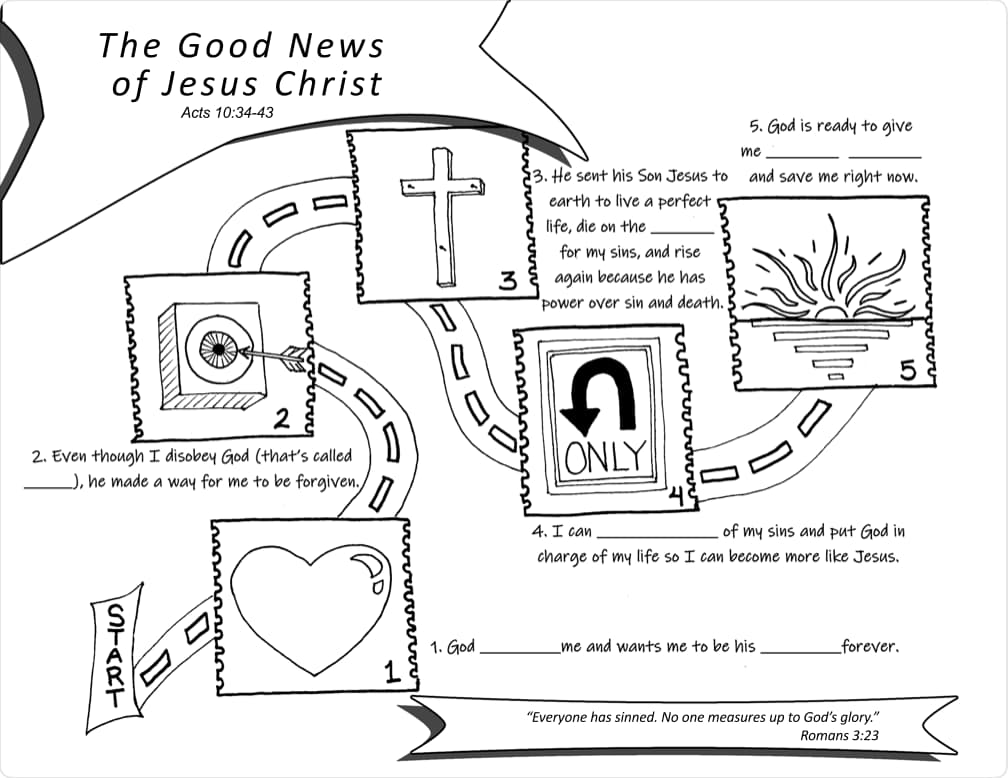
You can use this coloring sheet to have students follow along as you teach the 5 steps of the Good News Conversation
1Warm Up get your kids talking and engaged
What is the best news you've ever received?
Today, we're going to learn about the best news anyone has ever received! And you can receive and respond to that Good News today!
2Teach the Story teach a holistic story
This is a little bit of a different lesson than we usually teach. Since we covered the "story" aspect of this in the previous lesson (Peter & Cornelius), this lesson is about Peter's message of the Good News.
Use the Good News Conversation Guide to structure your lesson. Or use the "Good News Scavenger Hunt" activity below, which walks the kids through the steps of the Conversation Guide in a fun, interactive way.
3Bible Mastery give them basic Bible skills
4Comprehension Questions make sure they understand the story
First, ask the children if they have any questions about the story. What to do if you don't know the answer?
- Peter told Cornelius that the good news is that we can have peace with who?
- God (Acts 10:36)
- Who makes it possible for us to have peace with God?
- Jesus (Acts 10:36)
- According to Peter, what did Jesus do while he was here on earth?
- He did good things for people, like healing them and delivering them from evil spirits (Acts 10:38)
- How did Jesus die?
- The religious leaders killed him on a cross (Acts 10:39)
- What happened on the 3rd day after Jesus died?
- He rose from the grave! (Acts 10:39)
- What do you receive if you believe and trust in Jesus?
- Forgiveness of sins (Acts 10:43)
5Faith Questions open up a conversation about faith and the gospel; close with prayer
- (Use the Good News Conversation Guide to give your kids an opportunity to respond to the Good News, or use the question below.)
- When we learn the stories of the Bible, we learn how much God loves us and how he sent Jesus to die on a cross for our sins and to rise from the grave on the third day to give us peace with God and eternal life. Have you made Jesus the Lord of your life and received forgiveness for your sins?
6Memory Verse hide God's Word in their heart
All 5 activities below are free to use with no sign-up — complete with instructions, supply lists, and an age label for all-ages, early elementary, or late elementary classes.
Salvation Keychain
- Tie one end of the cord to make a knot.
- Add your beads in order
Explain the meaning of each bead as you add them.
- Gray is for sin. "For all have sinned and fall short of the glory of God." Romans 3:23
- Red is for the blood Jesus shed. "For God so loved the world, that he gave his only Son, that whoever believes in him should not perish but have eternal life." John 3:16
- White tells us we are clean and forgiven. "Purify me from my sins,and I will be clean; wash me, and I will be whiter than snow." Psalm 51:7
- Blue reminds us of baptism Peter replied, "Each of you must repent of your sins and turn to God, and be baptized in the name of Jesus Christ for the forgiveness of your sins. Then you will receive the gift of the Holy Spirit." Acts 2:38
- Green reminds us to grow in God’s love. "Rather, you must grow in the grace and knowledge of our Lord and Savior Jesus Christ. All glory to him, both now and forever! Amen." 2 Peter 3:18
- Yellow stands for the promise of eternal life. "There is more than enough room in my Father’s home. If this were not so, would I have told you that I am going to prepare a place for you? When everything is ready, I will come and get you, so that you will always be with me where I am." John 14:2-3
- Gray is for sin. "For all have sinned and fall short of the glory of God." Romans 3:23
- Tie the clasp to the end of the cord.
Gospel Bag
- Give each child a bag.
- Pass out items, as you explain what they mean.
- God loves us- Give them a heart trinket
- We make wrong choices (sin) and it hurts God. Give them a bandaid
- Jesus came to take our punishment for the wrong choices (sin). Give them a cross or mini Jesus figure
- Repent means to say you are sorry and ask for God's help to stop sinning. Give them a printed U Turn card.
- When we choose him, he gives us eternal life. Give them a sunshine sticker.
Jesus Sticker Sheet
- Give each child a strip of paper
- Tell them God loves them and wants to be their friend.
- Give them a heart sticker to add to their strip.
- We all make bad choices that hurt God's feelings, but he gave us a way to be forgiven
- Give them a sad face sticker to add to their strip.
- Jesus came to die on the cross to take our punishment.
- Give them a cross sticker to add to their strip.
- We can be good friends with Jesus forever.
- Give them a Jesus sticker to add to their strip.
Good News Scavenger Hunt
Use this Scavenger Hunt to lead your kids through the Good News Conversation.
- Download the Good News Scavenger Hunt Materials below
- Choose where your stations will be and what your "target" game will be.
- Type in the first page of the materials where your stations will be.
- Print the teacher guides and clue cards.
Gospel Mini Books
- Purchase or make mini books.
- Teach each section of the gospel.
- Have the kids glue or write the gospel truth to the correct page.
- green- God loves me and wants me to be his friend forever.
- black- Even though I disobey God (that's called sin), he made a way for me to be forgiven.
- red- He sent his Son Jesus to earth to live a perfect life, die on the cross for my sins, and rise again because he has power over sin and death.
- white- I can repent of my sins and put God in charge of my life so I can become more like Jesus.
- blue- I can follow Jesus by being baptized
- yellow- God is ready to give me eternal life and save me right now.
Running a kids’ ministry or Sunday school?
Ministry Edition gives your whole team lesson scheduling and teacher tools — all in one place.