Background Scripture (read 2-3 times during the week)
Story Summary
Jesus Heals a Man Born Blind (John 9)
Jesus saw a man who had been blind from birth. His disciples assumed that someone who was born blind was a result of sin, but Jesus told them that it wasn't because of sin, but that this man being born blind would now be an opportunity for God to be glorified. He spit on the ground, made mud out of the dirt, and then placed the mud over the man's eyes. He sent him to wash the mud off at the Pool of Siloam. When he rinsed off the mud, he could see! Everyone who knew him knew that he had been a beggar. In those days, there wasn't anything else someone who was born could do to earn money. They were amazed, and the man only had one answer to the question of how it had happened: the man they call Jesus had healed him.
The Pharisees caught wind of this miracle and instead of being glad that the man had been healed, they were mad at Jesus for doing the healing on the Sabbath. The Sabbath was to be a day of rest for those in Israel, and the Pharisees had added so many rules to it that it became a burden to even try to rest! After interrogating the man and his parents, their only conclusion was that everyone involved was evil: the man who had been healed and Jesus. But Jesus had a different conclusion: the Pharisees were spiritually blind even though they thought they could see, and that was worse than being physically blind.
Why Was the Man Born Blind?
Jesus' disciples assumed that someone had to sin in order for this person to be born blind. They weren't asking if this was the cause. They asked who was the cause. Jesus told them that his blindness was not because of sin, but instead would be used to show God's glory.
First, it wasn't very kind to ask this question right in front of the man. It seems like this is an example of talking about someone in front of them in the 3rd person. Not great social skills!
Second, this assumption is one that many still have today. If something isn't quite right, it must be someone's sin that caused it! While it is certainly true that the Original Sin is the cause of the Fall, Jesus taught them (and us!) something very important here. God is more interested in taking hardships and using them for his glory than he is in preventing them from happening in the first place.
Why Did Jesus Heal the Blind Man with Mud?
Jesus could have just spoken a word to the man to heal him. He could have just thought it. In the story of the woman healed of the issue of blood (see Mark 5:25-34), it doesn't even seem like Jesus was aware that he was healing her! So why did the "Son of Man" (the Messiah, God in the flesh) decide to heal the man who was born blind with spit and dirt made into mud? And why did he send him to the Pool of Siloam to wash it off before he could see? The short answer is, the Bible doesn't tell us!
But we can meditate (deeply think on) this story and perhaps learn something about Jesus and us. These are great questions to ask the kids (especially older elementary kids) to see what they come up with. Here are some thoughts that might help us dig a little:
- Maybe Jesus just wanted to make sure people saw the miracle by making it even harder? Before he could see, he had to get even more blind by having mud caked on his eyes. This would be like Elijah throwing water on the altar at Mount Carmel before God came down and consumed the sacrifice.
- Maybe this turned into a bigger test of faith for the man. Not only did he have to believe in his mind, he had to believe in his heart and put action to his belief. He had to go to the place Jesus told him (the Pool of Siloam).
- John does give us a clue by pointing out that "Siloam" means "sent." Surely that has something to do with it? Jesus was sent by the Father to the earth (see John 20:21). Maybe the man realized that he was now sent by Jesus to tell others about what he had done?
- Because it was the Sabbath (more on that below), maybe Jesus was just making sure that what he did was going to break the "law" the Pharisees had made up about how to keep the Sabbath. He was poking at them, wanting to show how ridiculous they had become.
Where Was the Pool of Siloam?
As we just mentioned, it does seem significant that Jesus sent the man to the Pool of Siloam to wash the mud off his eyes. This pool had a rich history in the Old Testament. Don't think of a pool with a diving board. This is more of a collection of water in the middle of a city, more like the pool that you might find a fountain in.
From King Hezekiah, to Nehemiah, to Jesus, the Pool of Siloam provides a rich background to this story. Check out this great article on GotQuestions.org about the Pool of Siloam.
Why Were the Pharisees Angry That Jesus Healed on the Sabbath?
They were angry that Jesus was "working" on the Sabbath.
What is the Sabbath?
The Sabbath is a special day created by God when he created the heavens and the earth, right at the beginning of the Story. He gave it as a gift to help people know their limits, to rest, recharge, and spend time with Him and their families.
The Creation Story (Genesis 2:2–3): God made the heavens and the earth in six days. On the seventh day, He rested, not because He was tired, but to set a pattern for us to follow and to make that day holy.
The 4th Commandment (Exodus 20:8–11): When God gave the Ten Commandments to his new people, He said, "Remember the Sabbath day by keeping it holy." He commanded that no heavy work be done on the seventh day.
What Should the Sabbath Look Like?
We see in Genesis 2:2-3 that "By the seventh day God had finished the work he had been doing. So on that day he rested from all his work. God blessed the seventh day and made it holy."
- First, we stop and rest. God created our bodies and minds to need a break. The Sabbath is a day to hit "pause" on our normal work.
- Then, we celebrate. The Sabbath isn't supposed to be a boring day of rules. It is a day to enjoy God's creation, good food and quality time with the people we love.
- Finally, we worship. God made the day holy (set apart as different than the other days) to remind us that He is holy. He is the one who created us and we can worship him and rely on him to meet our needs.
How did the Pharisees Distort the Sabbath?
But by the time Jesus did this miracle, the Pharisees had turned the Sabbath into a burden for people, with all sorts of rules. In the New Testament, Jesus explained the purpose of the Sabbath (Mark 2:27). He reminded people that "The Sabbath was made for man, not man for the Sabbath.” This means God gave us the Sabbath as a loving gift to help us rest, find joy in our day, and draw us closer to Him, not as a list of strict rules to follow that turn into a burden.
What Does John 9 Teach Us About Spiritual Blindness?
Jesus said an amazing thing to the man: "I am the light of the world." Jesus clearly claimed to be God - the light that was present on Day 1 of Creation (before the sun was created), and the light that would be present in the New Creation (see Revelation 21:23). The Pharisees thought they could see, but they were spiritually blind. This man was born blind, but he was able to see the spiritual reality that Jesus was the long awaited Messiah.
My Notes
What You Will Need
Supplies
- mud
Snack
mud pie
Video Options
From Saddleback Kids
From Crossroads Kids Club. This video includes many miracles, one of which is Jesus healing the man born blind.
Resource Sheet
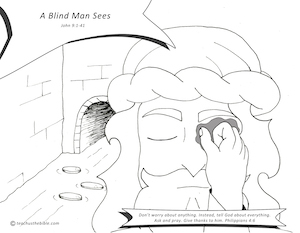
This coloring sheet depicts the blind man wiping the mud off his eyes that Jesus used to heal him.
1 Warm Up get your kids talking and engaged
Do you like to play in the mud?
Today, we are going to learn about a time when Jesus made mud with his own spit and used it to do something really amazing!
2 Teach the Story teach a holistic story
Read story from a Children's storybook Bible for younger children.
For older children, read the story from an age-appropriate Children's storybook Bible or read directly from the Bible.
3 Bible Mastery give them basic Bible skills
Scripture for Kids to Read Aloud John 9:1-23
4 Comprehension Questions make sure they understand the story
First, ask the children if they have any questions about the story. What to do if you don't know the answer?
- What question did the disciples ask about the man they passed who was blind from birth?
- Who sinned to cause this man to be blind
- What was Jesus' answer?
- No one sinned, but the man's blindness would be used to bring glory to God
- How did Jesus heal the man?
- He made mud with his spit, put it on his eyes, and told him to go wash it off in the Pool of Siloam
- Why were the Pharisees upset at Jesus?
- He healed the man on the Sabbath, or Saturday
- What did the Pharisees initially think about this?
- That this man wasn't really blind from birth, that he just looked like the man
- Who convinced them that he was really the same man who was blind from birth?
- His parents
- What did the Pharisees do to the man after he kept insisting that Jesus healed him?
- They threw him out of the synagogue
- What did Jesus do after they threw the man out?
- He went searching for him, found him, and asked him if he believed in the Son of Man, or the Messiah
- How did the man answer
- He asked Jesus who the Son of Man was, and after Jesus revealed that he was the Son of Man, the man believed in Jesus
5 Faith Questions open up a conversation about faith and the gospel; close with prayer
- In this story, the man born blind believed Jesus was the messiah or God himself.
- Do you believe that Jesus is God?
6 Memory Verse hide God's Word in their heart
All 8 activities below are free to use with no sign-up — complete with instructions, supply lists, and an age label for all-ages, early elementary, or late elementary classes.
Blind Man's Bluff
- Choose one child to be "it."
- Blindfold "It."
- Turn "It" around a few times.
- Let "it" try to tag one of the other children, who will then become "it".
Blind Man Obstacle Course Relay
- Create an obstacle course.
- Divide children into two teams.
- Each team chooses someone to navigate the course. This person is blindfolded.
- Each team takes turns navigating their blindfolded teammate through the course.
- The team that gets their teammate through the course the fastest, wins.
- You can change the obstacle course around and play again.
- The team members must work together to give directions to the blindfolded teammate.
Blind Man Mud Game
- Tape the picture of the blind man onto the wall.
- You might want to put a trash bag on the wall behind the picture to protect the wall.
- Blindfold child.
- Ask them to paint mud onto the man's eyes. (Like pin the tail on the donkey)
- Wipe the picture clean between each child's turn.
Blind Drawing
- Blindfold each student.
- Give them a piece of paper and crayons.
- Ask them to draw a picture of their house.
- Place newspaper or a plastic tablecloth on the table for easy clean up, especially if children are young and more apt to color on table.
Reading Braille
- Provide braille books for your students to practice reading.
- Or, escort them around your church looking for braille on signs (like restroom signs).
- Bring a mobile device with the braille alphabet and see if they can decode the letters on the sign.
Mud painting
- Give each child a small bowl of dirt. Allow them to add a small amount of water to make mud.
- They can stir with their hands or use a paintbrush.
- Allow students to "paint" with the mud.
Mud Sling
- Trace a person onto cardboard and cut out.
- Draw eyes onto the cut out.
- Optional: place contact paper over cardboard.
- Place cardboard cutout up against an outside wall (not near windows).
- Have students take turns throwing mud at the person to try and get mud onto eyes.
- Make sure mud is thick, so it isn't a runny mess at they throw it.
Guess What's in the Bag
- Put one object in each paper bag (a toy car, play dough, a piece of chalk, a comb, a small cup, etc.)
- Let the children take turns sticking their hand in a bag and trying to guess what object is inside without looking.
Running a kids’ ministry or Sunday school?
Ministry Edition gives your whole team lesson scheduling and teacher tools — all in one place.