Major and Minor Prophets in the Bible: A List for Kids New
44. Major & Minor Prophets
Lesson Prep During the week, before you teach
Major & Minor Prophets Story Summary for Kids
This lesson is about the many prophets written about in the Old Testament.
We have already learned about several prophets - Samuel, Elijah, Elisha, and Jonah to name a few. What did they have in common? They were people chosen by God to speak his message to the people (mostly to Israel and Judah, but sometimes to foreign countries as well). These were men who listened to the voice of God and were faithful to tell the word of God to those who needed to hear it, even if it meant they weren't very popular.
What's the Difference Between Major and Minor Prophets?
There are many stories in the Old Testament about prophets. In fact, there is an entire section of the Old Testament that we refer to as the "Prophets." They are mostly towards the end of the Old Testament, and they are known as either Major or Minor Prophets. Now, just because a book is referred to as a Major Prophet doesn't mean that the prophet was more important than one of the Minor Prophets. It just means that the book was longer!
List of the Major and Minor Prophets
Major Prophets
Minor Prophets
Isaiah
Jeremiah
Lamentations
Ezekiel
Daniel
Hosea
Joel
Amos
Obadiah
Jonah
Micah
Nahum
Habakkuk
Zephaniah
Haggai
Zechariah
Malachi
Some of the prophets were told to speak God's word to the Northern Kingdom, and some to the Southern Kingdom. Some were called to speak to Israel and Judah in their captivities (we will learn more about that in the next lesson). Some were called to bring messages from God to other countries.
Take some time to reflect on the Old Testament history we have covered so far. What message do you think God wanted to send to Israel and Judah? Most often, it was a message of judgment (which is why prophets weren't exactly looked upon kindly sometimes). But sometimes it was one of a promised savior in the future. The theme of sackcloth and ashes as a symbol of mourning or repentance is seen many times in the prophets. Sackcloth was an extremely rough and itchy material used to make sacks. When they wore it as clothing and placed ashes on their head, they were intentionally making themselves uncomfortable to show their deep inner discomfort - either in mourning or because they were deeply sorry for their sins.
The Prophetic Books and Their Themes
Here is an overview of the prophetic books and their major themes (adapted from Bible Gateway's tour of the Bible: Major Prophets and Minor Prophets)
Book
Theme
Isaiah
Isaiah called Judah and its kings to repent and come back to God or face judgment. A major theme of Isaiah is that Judah's kings were trusting in the nations around them to protect them from Assyria and Babylon. But God was using Assyria and Babylon for his purposes. There are many prophecies in Isaiah related to the coming Messiah (Isaiah 53:4-6)
Jeremiah
Jeremiah was a "doom and gloom" prophet who warned Judah of judgment if they did not repent. Unfortunately, they didn't repent and the judgment he foretold came true.
Lamentations
Lamentations is sort of like a long Psalm by Jeremiah about just one topic: Jerusalem and Judah's sin.
Ezekiel
Ezekiel prophesied to Judah during their time in exile in Babylon, encouraging them to have faith that God would bring them home.
Daniel
Daniel was also a prophet to Judah during their captivity in Babylon. We will learn about some of the more famous stories in the book of Daniel in coming lessons. A major theme of the book of Daniel is that God is in charge of every nation and empire.
Hosea
Hosea called Israel back to God. Israel had begun worshiping other gods and was unfaithful to the one true God. Hosea is known for being a personal object lesson for Israel as God called him to marry an unfaithful woman to show Israel what they were doing to him. In the end, God still loved Israel.
Joel
Joel was a prophet to Judah and warned them that they must repent or face judgment.
Amos
Amos was a shepherd who was called by God to tell Israel to stop mistreating the poor among them.
Obadiah
Obadiah is just one chapter long and is a prophecy against the nation of Edom because they were hostile to Jacob's descendants. Remember, Edom was the name given to Esau, Jacob's twin brother.
Jonah
We just learned about Jonah in the last lesson. He was called to prophesy against the city of Nineveh.
Micah
Micah warned Judah to turn back to God or face judgment. He also called them to treat each other with justice and mercy, and that a ruler was going to come from Bethlehem to set things back right.
Nahum
Nahum prophesied against Nineveh, the capital of Assyria (just like Jonah), but this time after the Assyrians had captured the Northern Kingdom of Israel. Nahum told Assyria that God was going to judge them for what they did to Israel.
Habakkuk
Habakkuk is a book of questions that he had for God. It is similar to the Psalms as it is an honest conversation Habakkuk is having with God about the evil in the world and what God is going to do about it.
Zephaniah
Zephaniah called Judah back to God and promised that the faithful could look forward to when God judged the wicked, what God called the "Day of the Lord."
Haggai
Haggai prophesied to Judah as they were coming back from exile in Babylon and beginning to rebuild Jerusalem. He was writing to encourage them to get back to rebuilding the temple.
Zechariah
Zechariah prophesied to those who were returning to Judah from exile in Babylon. He gave some striking prophecies that were fulfilled in the person of Jesus (Zechariah 9:9-10)
Malachi
Malachi prophesied to Judah after they returned from Exile in Babylon and called for them to repent from their half-hearted worship.
In What Order Do the Prophets Appear in the Bible?
Isaiah
Jeremiah
Lamentations
Ezekiel
Daniel
Hosea
Joel
Amos
Obadiah
Jonah
Micah
Nahum
Habakkuk
Zephaniah
Haggai
Zechariah
Malachi
In Christian Bibles, Malachi is the last book of the Old Testament. After Malachi comes the New Testament and the long-awaited Messiah!
triscuits (like burlap), crushed oreos mixed with powdered sugar over pudding (like ashes)
Video Options
God's Story - Prophets
From Crossroads Kids Club
God's Story - Isaiah
From Crossroads Kids Club
Resource Sheet
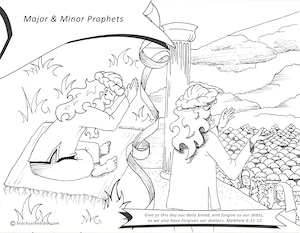
Major and Minor Prophets Coloring Sheet
This coloring sheet depicts an Old Testament prophet praying and receiving a word from God and then telling that word to the people.
Lesson In class, six steps
1Warm Up get your kids talking and engaged
Have you ever had to take a message from someone for your parents? What was the message? Did you remember to give the message to them?
Today, we are going to learn about the men in the Old Testament who had a job to bring a message from God to the people of Israel and Judah.
2Teach the Story teach a holistic story
This lesson is a bit different from most Teach Us the Bible lessons in that it doesn't revolve around a single story. You should give them an overview of the Prophets, with the information in the "Story Summary" above as a guide. The key things to get across to them are:
Prophets heard a message directly from God and had to be obedient to give that message to the people
Prophets told the people to repent or stop sinning or God would judge them (show sackcloth and ashes as you make this point)
Prophets told the people of things that would happen in the future (including the coming Messiah, Jesus)
Many books in the Old Testament were called Major or Minor Prophets, depending on the length of the book, and they recorded the messages God gave the people
The Egermeier's Bible Story Book contains a nice summary of some of the Minor Prophets in their story called "Five Other Prophets" that you could read to the children as well.
Why would the prophets or the people of Israel and Judah wear sackcloth and put ashes on their heads?
To show their deep desire to repent or to mourn something bad happening
5Faith Questions open up a conversation about faith and the gospel; close with prayer
The major theme of the prophets was that the people of Israel needed to repent or face judgment. Also, another theme was that a coming Messiah would soon deliver them.
The person of Jesus fulfilled all the prophecies in the Old Testament concerning the Messiah and he took the judgment we deserve for our sins on himself. Have you trusted in Jesus as your Savior?
6Memory Verse hide God's Word in their heart
Give us this day our daily bread, and forgive us our debts, as we also have forgiven our debtors. Matthew 6:11-12
Crafts, Games, and Activities for Major & Minor Prophets After the Lesson, give them a catalyst to remember the Story
10 activities
All 10 activities below are free to use with no sign-up — complete with instructions, supply lists, and an age label for all-ages, early elementary, or late elementary classes.
Crafts
4
Draw what cars, houses and daily life might look like 100 years from now, as prophets spoke of the future.
drawing/coloring supplies, paper
Instructions
What's in the future?
AllCrafts
Draw what cars, houses and daily life might look like 100 years from now, as prophets spoke of the future.
Supplies
drawing/coloring supplies
paper
Instructions
What do you think the future will be like?
Times have changed a lot over history.
Have students draw pictures of cars, houses, ways of living, 100 years from now.
The prophets often told about events that were going to happen in the future.
Early Elem.
Glue burlap over a person outline and finger-paint ashes on the head for sackcloth and ashes.
person outline sheet (see below), pieces of burlap, +1
Instructions
Sack and Ashes Craft
Early Elem.Crafts
Glue burlap over a person outline and finger-paint ashes on the head for sackcloth and ashes.
Then I turned my face to the Lord God, seeking him by prayer and pleas for mercy with fasting and sackcloth and ashes. Daniel 9:3 (ESV)
Supplies
person outline sheet (see below)
pieces of burlap
ashes
Instructions
Glue burlap sack to cover the body of the person.
Using your finger, paint ashes onto the person's head.
Draw a picture for your parents and add a message to them, the way prophets delivered God's messages.
construction paper, crayons or markers
Instructions
Delivering a Message to Your Parents
Early Elem.Crafts
Draw a picture for your parents and add a message to them, the way prophets delivered God's messages.
Then the Lord reached out his hand. He touched my mouth and spoke to me. He said, "I have put my words in your mouth. Today I am appointing you to speak to nations and kingdoms. I want you to pull them up by the roots and tear them down. I want you to destroy them and crush them. But I also want you to build them up and plant them." Jeremiah 1:9-10
Supplies
construction paper
crayons or markers
Instructions
Prophets delivered messages to the Israelites.
In this activity, children will deliver a message to their parents.
Give them each a sheet of paper and coloring supplies.
Tell them to draw a picture for their parents. Then ask them what message they want to give to their parents, or what they would like to say to their parents in the picture.
Have the children write their message on the picture, or if they are not able, write it for them and sign their name.
Late Elem.
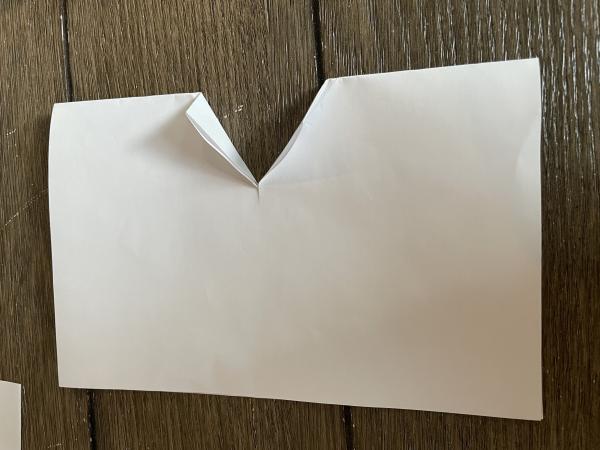
Fold and cut paper into a card with a mouth that opens and closes, then draw a face around it.
white paper, scissors, +1
Instructions
Talking Card
Late Elem.Crafts
Fold and cut paper into a card with a mouth that opens and closes, then draw a face around it.
Then the Lord reached out his hand. He touched my mouth and spoke to me. He said, "I have put my words in your mouth. Today I am appointing you to speak to nations and kingdoms." Jeremiah 1:9
Supplies
white paper
scissors
crayons
Instructions
Fold paper in half, like a card.
Cut a slit about 2 inches long, perpendicular to the fold.
Fold up the top piece to make a triangle
Fold down the bottom piece to make another triangle.
Open the paper and fold the triangles inward.
It looks like a mouth!
Have kids draw a face around the mouth.
Photos
Games
4
Whisper a message down a line and hear how mixed up it gets, unlike God's direct word to the prophets.
No supplies
Instructions
Telephone Game
AllGames
Whisper a message down a line and hear how mixed up it gets, unlike God's direct word to the prophets.
Then the Lord reached out his hand. He touched my mouth and spoke to me. He said, "I have put my words in your mouth. Today I am appointing you to speak to nations and kingdoms. I want you to pull them up by the roots and tear them down. I want you to destroy them and crush them. But I also want you to build them up and plant them." Jeremiah 1:9-10
Supplies
No supplies needed
Instructions
Have students sit or stand in a line.
Whisper a message into the ear of the first student in line.
That student will whisper the same message in the ear of the person next to them and so on down the line.
Have them pass the message on fairly quickly.
The message gets mixed up by the time it gets to the end!
It is a good thing prophets got a direct message from God to pass on to His people!
Listen closely to find a hidden ticking clock, or copy a clapped rhythm, as prophets listened to God.
loud ticking clock
Instructions
Listen Carefully!
AllGames
Listen closely to find a hidden ticking clock, or copy a clapped rhythm, as prophets listened to God.
That's what the glory of the Lord looked like. When I saw it, I fell with my face toward the ground. Then I heard the voice of someone speaking. Ezekiel 1:28b
Supplies
loud ticking clock
Instructions
Prophets had to listen carefully to God.
Hide a loud ticking clock or other object that makes a quiet noise.
Students must listen carefully to find the clock.
OR
clap and pat a rhythm and have students listen and copy the rhythm.
Play Simon Says, listening carefully and obeying, as the prophets did with God's words.
No supplies
Instructions
Simon Says
AllGames
Play Simon Says, listening carefully and obeying, as the prophets did with God's words.
Then the Lord reached out his hand. He touched my mouth and spoke to me. He said, "I have put my words in your mouth. Today I am appointing you to speak to nations and kingdoms. I want you to pull them up by the roots and tear them down. I want you to destroy them and crush them. But I also want you to build them up and plant them." Jeremiah 1:9-10
Supplies
No supplies needed
Instructions
The Prophets not only had to listen to God, they also had to be obedient in speaking His words to the people.
Play Simon Says.
Children must listen and follow actions correctly.
Step forward on the times called out, then race back without getting tagged when the leader shouts REPENT.
No supplies
Instructions
Repentance Game
AllGames
Step forward on the times called out, then race back without getting tagged when the leader shouts REPENT.
Heads up. large play area
So I will judge you people. I will judge each of you in keeping with what you have done," announces the Lord and King.
"Turn away from your sins! Turn away from all of the evil things you have done. Then sin will not bring you down. Get rid of all of the evil things you have done. Let me give you a new heart and a new spirit. Then you will be faithful to me. Why should you die, people of Israel? Ezekiel 18:30-31
Supplies
No supplies needed
Instructions
Have students line up on one end of playing area.
Have an adult go to other end of playing area, with back to students.
Have one child call out "What time is it?"
The adult at the other end calls out a time.
If adult says 10:00, then students take 10 steps forward. 2:00 means take 2 steps, etc
Before any student reaches the end, yell out "REPENT!"
All the students must turn around and run back to the starting line, without getting tagged by adult.
Any students that get caught are out.
It is good to use an adult as the tagger because it allows for you to choose whom to tag out. You don't want your slowest children to be the only ones tagged each time.
Story & Reflection
1
Take turns wearing an itchy burlap sack and get a smudge of ashes on the forehead.
burlap sack, ashes
Instructions
Wearing Sackcloth and Ashes
AllStory & Reflection
Take turns wearing an itchy burlap sack and get a smudge of ashes on the forehead.
Then I turned my face to the Lord God, seeking him by prayer and pleas for mercy with fasting and sackcloth and ashes. Daniel 9:3 (ESV)
Supplies
burlap sack
ashes
Instructions
Cut a hole in burlap sack to fit over your head.
Cut holes in the sides for arms.
Have students take turns putting on the sack.
They will feel how itchy it is and how uncomfortable it makes them feel.
Place a bit of ashes on each of the students' foreheads.
Worksheets
1
Late Elem.
Cut out the prophets' names and glue each one under Major or Minor.
scissors, glue, +1
Instructions
Major and Minor Prophets Sorting
Late Elem.Worksheets
Cut out the prophets' names and glue each one under Major or Minor.
Major & Minor Prophets
Supplies
scissors
glue
cut out sheet for each student (see below)
Instructions
Have the students cut out the names of the prophets and glue onto the appropriate side (Major or Minor prophet)
That's 5 lesson PDFs this month — which is right about where the free samples end and Ministry Edition begins.
Ministry Edition gives your whole team unlimited lesson PDFs, plus scheduling, teacher emails, and take-home sheets for parents.
Rate this Activity
Lesson Prep
Start your lesson planning by reading the "Lesson Prep" section about 5 days before you are scheduled to teach.
1
Background Scripture
While we provide a summary of the story, we strongly encourage you to read the story directly from the Bible for yourself. God's word is powerful (much more powerful than our summary is!) and you should know the story well before you teach it. We encourage you to read the background scripture 2–3 times during the week before teaching.
2
Story Summary
We provide a "Cliff's Notes" version of the story to help you see the big picture. Also, if you are not using a storybook Bible, you can use this summary as an outline for your own teaching in class.
3
What You Will Need
We place everything you might need to prepare for the actual story telling here (this doesn't include Reinforcement Activity supplies, because we don't know which ones you will choose!). This may include a snack suggestion if there is one that goes well with the story, props you might use in teaching the lesson, and the coloring sheet that goes with each lesson.
Lesson
This section helps you structure your teaching time.
1
Warm Up
This is a question that goes along with the story for the day. This is designed to get your kids talking and to build a connection with them.
2
Teach the Story
This is the most important part of the lesson. Use all the creativity you have to tell the story in an engaging, and interesting way. Use props. Be sensitive to the age of your children and tell the story in a way they can understand.
If you would like to have your students read out of the Bible themselves, these are good verses to do it. We recommend they do this after you teach the story, however, and certainly not as a substitute for you teaching a holistic story. While it is a good thing that kids get used to reading out loud and reading the Bible for themselves, elementary-aged children do not typically have the reading skills necessary to be able both read out loud and comprehend at the same time. Also, it is difficult for the other students to really understand what they are hearing. So teach the lesson first, then let them read the Scripture out loud.
4
Comprehension Questions
These questions can help you ensure your students understood the story. Also, use this time to take the topic where the students want to go. Pray for the Holy Spirit to reveal to them what truths he wants them to learn from the story, and help them understand how this story can be applied to their lives. Keep in mind that elementary school children are rarely capable of abstract thought, so don't boil it all down to a simplified principle for them. But let the Scripture and the Holy Spirit speak to them and be sensitive to where the conversation can go.
5
Faith Questions
These questions help the children think about how this story applies to their own life today. Keep in mind that only your oldest elementary school children will be able to think in abstract terms, but you can ask some basic questions that will hopefully open up a conversation about what the children believe. By the prompting of the Holy Spirit in response to His Word, you can encourage your children to surrender their lives to God and present the Gospel to them. Also, feel free to share your own faith experiences with them (being careful not to delve into "adult" struggles).
6
Memory Verse
We typically include a memory verse every 4 or 5 lessons, so you can work for several weeks on the same verse. Feel free to give out rewards to the students who successfully memorize the Scripture.
Reinforcement Activities
Use reinforcement activities to help your students remember the story. These activities are not just crafts and games.
Preparation
Several days before you teach, choose the activities you want to do with your class. Take note of any supplies that are needed. You might consider trying out crafts to make sure you know how to do them before you get to class.
Scripture
Every activity has a Scripture that helps you see the tie-in from the activity to the story. Make sure to help the students see the tie-in so they don't think you are just playing a random game.
When You Don't Know the Answer
Children naturally have questions. And sometimes, we don't know the answer! Here's what to do:
1Ask the child to say more about their question.
2Ask them what they think the answer may be. Perhaps they have the right answer and they just need confirmation.
3Pose the question to the whole class and see what discussion ensues.
4If all else fails, tell them that you don't know the answer (this is okay!) and that you will get back to them next week, but only if they will also think about it and do some research during the week as well. For younger students, you might write down their question on a piece of paper and send it home with them. But above all, follow up with the student the next week and continue your discussion with your newfound information.
(Adapted from "Children's Ministry in the Way of Jesus", by David M. Csinos and Ivy Beckwith)
Using Videos
Just wanted to point out here that you should follow all copyright laws when it comes to using videos.
Even if a video is on YouTube, that doesn't mean it is available for you to show in a group setting automatically.
Check with the video publisher for usage restrictions, whether you need to pay for a license to show a video, etc.
We include these videos as options for you to consider and for your own personal study.